
ADVERTISEMENT
Denzel Washington’s Mother Wept as Fordham Asked Him to Leave—Yet That Painful Academic Blow Created the Icon Who Won “Glory” in 1989
The Devastating Moment That Changed Everything
Denzel Washington sat in his mother’s beauty shop on March 27, 1975, a 20-year-old college dropout with a 1.8 GPA and a shattered dream. Fordham University had “politely suggested” he take time off—academic speak for asking him to leave. For a young man who had entered college with aspirations of becoming a doctor, then a lawyer, then a journalist, this moment represented complete failure.
His mother, Lennis Washington, who had invested her hopes and hard-earned money into her son’s education, was heartbroken. The disappointment was palpable. Here was her son, brilliant and capable, yet unable to find his path through the traditional academic maze that promised stability and success.
But what neither Denzel nor his mother knew was that this painful rejection would become the catalyst for one of Hollywood’s most remarkable careers—a journey that would lead to two Academy Awards, including his unforgettable performance in “Glory” (1989), and status as one of the greatest actors of his generation.
The Academic Spiral: From Pre-Med Dreams to Academic Probation
The Pre-Med Disaster
Denzel Washington entered Fordham University with the conventional ambitions of a young man seeking a stable, prestigious career. His first choice? Pre-medicine. It seemed like a solid path—respected, lucrative, and sure to make his family proud.
Then came “Cardiac Morphogenesis.”
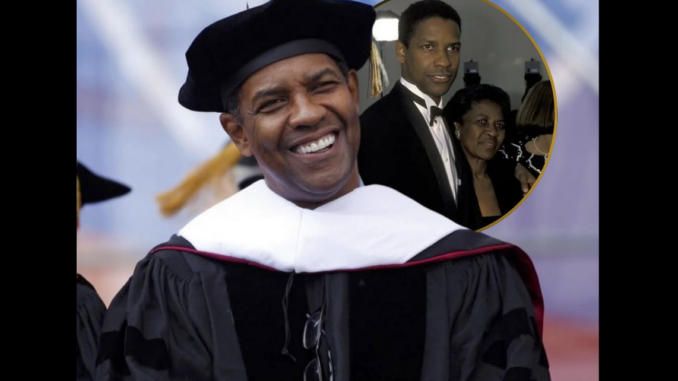
“I couldn’t pronounce it… and I couldn’t pass it,” Washington later recalled in his 2011 University of Pennsylvania commencement address. The complex science course became an insurmountable obstacle, exposing a fundamental truth: his heart wasn’t in medicine.
The Search for Direction
Refusing to give up, Washington pivoted to pre-law. Perhaps the courtroom would be his stage. When that didn’t resonate, he tried journalism. Each pivot reflected a young man desperately searching for purpose, trying to force himself into careers that looked good on paper but felt hollow in practice.
“With no academic focus, my grades took off in their own direction: down,” Washington admitted. His GPA plummeted to 1.8. The university’s patience wore thin.
The Painful Request to Leave
When Fordham University administrators suggested Washington take “some time off,” the message was clear. He was failing, and continuing down this path would only lead to more disappointment. For Washington, it was a crushing blow. For his mother, who had sacrificed to give her son opportunities, it was devastating.
This was supposed to be the generation that made it. The son who would achieve what his parents couldn’t. Instead, at 20 years old, Denzel Washington was a college dropout working in his mother’s beauty shop in Mount Vernon, New York.
The Divine Intervention: A Prophecy in a Beauty Salon
March 27, 1975: The Day Everything Changed
On an ordinary spring day, while Denzel was helping out in his mother’s beauty shop, an encounter occurred that would alter the trajectory of his life. An elderly woman from his mother’s church—one of the respected elders of Mount Vernon—sat getting her hair done. She kept giving young Denzel strange, penetrating looks.
Finally, she removed the hair dryer from her head and spoke words that would echo through the decades:
“Young boy, I have a spiritual prophecy: you are going to travel the world and speak to millions of people.”
The Skeptical Response
Washington, in his typical self-deprecating style, later admitted his immediate reaction: “Like a wise-ass, I’m thinking to myself: ‘Does she got anything in that crystal ball about me getting back to college in the fall?'”
He dismissed it. A prophecy? Speaking to millions? He was a college dropout with no direction, no prospects, and no plan. The woman’s words seemed like religious platitudes—well-meaning but disconnected from his harsh reality.
Yet something about that moment stuck with him. Perhaps it was the conviction in her voice. Perhaps it was the specificity of her prediction. Or perhaps, in his lowest moment, he needed something to hold onto—even if it seemed impossible.
The Summer That Changed Everything: Discovery at YMCA Camp
Taking a Counselor Job
That summer of 1975, Washington took a position as a counselor at a YMCA camp in Connecticut. It was meant to be a stopgap—a way to earn some money while figuring out his next move. He had no expectations beyond supervising children and making it through the summer.
The camp organized a talent show for the campers, a typical summer camp activity. Washington participated, probably thinking little of it beyond entertaining the kids.
The Life-Altering Suggestion
After the talent show, another counselor approached him with a simple observation: “Have you ever thought of acting? You should. You’re good at that.”
It was a casual comment, the kind of offhand remark that usually fades into forgotten conversation. But for Denzel Washington, it was an epiphany. Something clicked. Acting wasn’t on his radar—it wasn’t a “stable career,” wasn’t what his mother dreamed of, wasn’t part of any plan.
But for the first time in his struggling academic career, something felt right.
The Connection to Purpose
That moment at the camp crystallized what the church woman had prophesied months earlier. Speaking to people. Moving people. Connecting with audiences. Acting wasn’t just a career—it was a calling he hadn’t known he was searching for.
When Washington returned to Fordham that fall, he changed his major one final time: to Drama and Journalism. This time, it wasn’t a desperate pivot away from failure. It was a decisive move toward purpose.
From Academic Failure to “Glory”: The Rise of an Icon
Finding His Footing in Acting
Once Washington discovered acting, everything changed. The same young man who couldn’t focus on cardiac morphogenesis or legal theory suddenly found inexhaustible motivation. He threw himself into his craft with the intensity of someone who had finally found his home.
His early career wasn’t without rejection. He auditioned for a Broadway musical despite being unable to sing, choosing “Just My Imagination” by The Temptations and delivering what he later described as an embarrassing performance. “I didn’t quit. I didn’t fall back,” he said of that rejection and many others that followed.
The Breakthrough Years
Washington’s persistence paid off. After graduating from Fordham and earning an MFA from the American Conservatory Theater, he began building a career in theater and television. His role in the medical drama “St. Elsewhere” (1982-1988) brought him national recognition.
But it was his transition to film that transformed him into a legend.
“Glory” and Vindication
In 1989, Denzel Washington portrayed Private Trip in Edward Zwick’s “Glory,” a Civil War drama about the first African American volunteer infantry unit. His performance was electrifying—raw, powerful, and deeply moving. He brought to life a formerly enslaved man fighting for the Union Army with complexity and dignity.
When Washington won the Academy Award for Best Supporting Actor for “Glory,” it represented more than Hollywood recognition. It was vindication. The college dropout who couldn’t pass science classes, who had made his mother weep with disappointment, was now standing on the world’s biggest stage, holding Oscar gold.
That elderly woman’s prophecy had come true: Denzel Washington was indeed speaking to millions around the world—not through medicine or law, but through the transformative power of acting.
The Philosophy of Failing Forward
Embracing Failure as Fuel
In his 2011 commencement address at the University of Pennsylvania, Washington reflected on his journey with remarkable wisdom: “I’ve found that nothing in life is worthwhile unless you take risks. Nothing.”
He introduced the concept of “failing forward”—the idea that setbacks aren’t endpoints but redirections. “If I’m going to fall, I don’t want to fall back on anything, except my faith. I want to fall forward. At least I figure that way I’ll see what I’m about to hit.”
This philosophy didn’t come from success—it came from that painful moment when Fordham asked him to leave. From the embarrassment of bombing auditions. From every rejection that preceded breakthrough.
The Reggie Jackson Principle
Washington often cites Reggie Jackson, who struck out 2,600 times in his baseball career—the most in history at that time. “But you don’t hear about the strikeouts,” Washington notes. “People remember the home runs.”
Thomas Edison conducted 1,000 failed experiments before inventing the light bulb. “Every failed experiment is one step closer to success,” Washington emphasizes.
His academic failure at Fordham was experiment zero—the foundation upon which all future success was built.
The Message for Future Generations
“You Will Fail at Some Point in Your Life”
Washington’s message to graduates and anyone pursuing dreams is refreshingly honest: “You will fail at some point in your life. Accept it. You will lose. You will embarrass yourself. You will suck at something. There is no doubt about it.”
This isn’t pessimism—it’s liberation. Once you accept that failure is inevitable, you’re free to take the risks necessary for extraordinary achievement.
The Ghosts of Unfilled Potential
Washington shares a powerful visualization from motivational speaker Les Brown: Imagine you’re on your deathbed, surrounded by ghosts representing your unfilled potential—the ideas you never acted on, the talents you didn’t use.
“‘We came to you because you could have brought us to life,’ they say. ‘And now we go to the grave together.’ So I ask you today: How many ghosts are going to be around your bed when your time comes?”
For Washington, that moment at age 20, forced out of Fordham, could have been the death of his potential. Instead, it became the birth of his purpose.
Lessons from Denzel’s Journey
1. Academic Success Doesn’t Define You
Washington’s story demolishes the myth that traditional academic achievement is the only path to significance. He couldn’t pass pre-med courses. He struggled through multiple major changes. His GPA was dismal.
None of that mattered once he found his true calling.
2. Listen to Unexpected Voices
Two people changed Washington’s trajectory: an elderly church woman with a prophecy and a fellow camp counselor with a suggestion. Neither was a guidance counselor, professor, or career expert.
Sometimes the most important guidance comes from the least expected sources.
3. Failure Is Redirection, Not Rejection
Fordham didn’t reject Denzel Washington—the universe was redirecting him. What felt like doors closing was actually a pathway clearing. His inability to succeed in pre-med, pre-law, and journalism wasn’t failure; it was elimination of wrong options.
4. Timing Matters
If Washington had succeeded in medicine or law, the world would have gained a competent professional. By failing at those paths and discovering acting, the world gained a transformative artist.
Sometimes failure’s greatest gift is its timing—pushing you toward your destiny precisely when you’re ready to receive it.
The Full Circle: Theater to Film to Wisdom
The Court Theater Connection
In one of life’s poetic symmetries, Washington won his Tony Award for “Fences” in 2010 at the Court Theater—the same theater where he had bombed his singing audition 30 years earlier. The place of his early rejection became the site of his theatrical triumph.
Speaking to Millions
That woman in the beauty shop was right. Through films like “Glory,” “Malcolm X,” “Training Day,” “Fences,” and dozens more, Denzel Washington has literally spoken to millions—hundreds of millions—of people worldwide.
Not as a doctor explaining diagnoses. Not as a lawyer arguing cases. But as an actor illuminating the human experience, challenging audiences, and leaving lasting impact through storytelling.
A Mother’s Pride Restored
While Lennis Washington wept when her son left Fordham in academic failure, she lived to see him become one of the most respected actors in the world. The disappointment of 1975 transformed into immeasurable pride as she watched her son collect Academy Awards, speak at university commencements, and yes—travel the world speaking to millions.
Conclusion: The Gift Hidden in Failure
Denzel Washington’s journey from Fordham dropout to Hollywood icon proves that our greatest setbacks often contain our greatest opportunities. The moment that devastated his mother became the catalyst that freed him to discover his true calling.
His 1.8 GPA didn’t predict his future—it redirected it. Fordham’s request that he leave didn’t end his story—it began his real story. That summer job as a camp counselor wasn’t a backup plan—it was a divine appointment.
Today, when Washington stands before audiences sharing his philosophy of “failing forward,” he speaks with the authority of someone who lived it. The college dropout with no direction became the man who would portray Malcolm X, Nelson Mandela, and countless other legendary figures—precisely because he was brave enough to fail, wise enough to listen, and courageous enough to fall forward.
For anyone facing academic struggles, career uncertainty, or disappointment from loved ones, Washington’s story offers profound hope: Sometimes the worst thing that can happen is actually the best thing that could happen. You just can’t see it yet.
That woman in the beauty shop saw it. The camp counselor saw it. And eventually, Denzel Washington saw it too.
The question is: What is your failure trying to tell you? What path is it clearing? What calling is waiting on the other side of your disappointment?
As Washington himself would say: Fall forward. You never know what glory awaits.
—
Key Takeaways
- Academic failure doesn’t determine destiny**: Washington’s 1.8 GPA and forced leave from Fordham didn’t predict his future success
Listen to unexpected guidance: A church woman’s prophecy and a camp counselor’s suggestion changed everything
Summer jobs can be turning points: What seemed like a stopgap position became the moment of discovery
Failure is redirection Washington’s inability to succeed in pre-med, pre-law, and journalism cleared the path to acting
Persistence after failure matters most: Early rejections in acting didn’t stop him—they prepared him
Purpose creates motivation: Once Washington found acting, his focus and drive transformed completely
Maternal disappointment can become pride: The tears of 1975 became tears of joy as success unfolded
Prophecies sometimes come true: The prediction that he would “speak to millions” was literally fulfilled
The sites of failure can become sites of triumph: Winning a Tony at the same theater where he failed an audition 30 years earlier
Your calling might not look: “stable Acting wasn’t the safe choice, but it was the right choice
—
ADVERTISEMENT
*This article draws from Denzel Washington’s 2011 University of Pennsylvania commencement address, where he candidly shared his journey from academic failure to Hollywood success, offering inspiration to anyone facing setbacks in pursuit of their dreams.*
Leave a Reply